

Communication Tools and Therapies for Autism

Communication is a fundamental skill that allows us to connect with the people around us, and share our thoughts, needs and feelings. Communication can be verbal or non-verbal, written or spoken, and combines language, speech, gestures, facial expressions, and social interactions. Being able to communicate successfully requires skills in both both receptive language (making sense of words, gestures, and facial expressions) and expressive language (how we send our messages to others).
Children with autism may show different preferences in how they communicate or may even find communication challenging. We all have a role to play in understanding different communication needs and supporting people living with autism to connect with others. Early Start Australia therapists work closely with parents, carers and teachers to help support and extend your child’s communications skills in their everyday environments.
What Communication Challenges Do Autistic Individuals Face?
People with autism have a wide range of communication abilities can face a range of challenges around connecting with others. Some people can speak fluently while some may only be able to communicate non-verbally. Therapies and communication supports are therefore different for each individual, depending on their unique strengths and abilities.
Verbal Communication Differences
The diverse ways that people with autism connect with others can be different from how other people express themselves or how we typically engage in communication. People with autism may naturally:
- have difficulty understanding facial expressions
- use direct, literal or matter-of-fact language
- use different sounds or tones, made up words, robotic or monotone, high-pitched or excessively loud speech, or different accents
- repeat words and phrases (sometimes referred to as ‘echolalia) to ask for something they want, draw attention to something, indicate that they either agree or disagree or as a form of self-soothing or stimming
- talk endlessly about their special interests and passions
- interrupt others with their ideas and thoughts
And they may need our support:
- timing a back-and-forth conversation
- when the conversation topic changes
- processing what has been said
- managing non-relevant trains of thought
- interpreting non-literal references, such as sarcasm, analogies or metaphors, figures of speech
- understanding how words can change meaning in certain contexts
Nonverbal Communication Differences
Some autistic individuals may have difficulty using or interpreting non-verbal communication such as use of eye contact, facial expressions or gestures, socially appropriate personal space or tonal cues such as a rising tone at the end of a question.
Other children with autism use nonverbal communication regularly. They might physically manipulate a person by pushing your hand or body towards something they want or handing a toy to someone to indicate that they need help. Some children may copy body language they observe and might use these movements in contexts in which they do not make sense or are not appropriate.
Observable behaviour can also tell us a lot about what someone is trying to communicate. Some behaviours may help children to communicate that they are unhappy, confused or scared or that they want or need something. This may come across as a child who refuses instructions, has meltdowns or behaves aggressively. Many children with autism engage in repetitive movements, such as flapping their hands or flicking their fingers when excited or nervous. These are commonly called ‘stimming behaviours,’ and can help children express and regulate their emotions to navigate situations they might find overwhelming.
Most behaviours we come across are safe and natural and when understood can be celebrated. However sometimes behaviours can cause you concern, for example they may involve your child harming themselves or other people. If you feel this is the case, it is important to seek professional advice to understand the purpose of these behaviours for your child and help them to identify safer and more positive alternatives.
Social Communication and Pragmatics
The subtle nuance of socialising seamlessly with others means that many of us take social communication for granted, however individuals with autism typically have difficulty perceiving or adapting to social dynamics and how context contributes to meaning (social pragmatics).
For people with autism understanding and using social cues may lead to misunderstandings or different interpretations about what has been said. This may result in people giving an unsuitable response or seeming to act inappropriately. Further, a lack of understanding and awareness about social expectations make it difficult for people with autism to regularly engage in mutually rewarding social interactions. These differences in communication preferences should not be misinterpreted as a lack of consideration.
It is everyone’s responsibility to build inclusive environments and educate our communities in ways that support diverse communication styles, respect individuality and celebrate our differences.
What Tools Are Commonly Used to Improve Communication in Autism?
A wide range of evidence-based interventions and supports are available to minimise the negative impacts of autism on the ability to communicate effectively and meaningfully.
1. Speech Therapy
For those with some verbal abilities, speech therapy can help improve communications skills. Starting with the basic abilities to produce comprehensible sounds, understand and use words or construct sentences, many children with autism benefit from both the direct intervention of a speech therapist and from the understanding and methods that therapists pass on to parents and other carers.
2. Augmentative and Alternative Communication (AAC)
For those with very limited or no verbal abilities, augmentative and alternative communication techniques, devices and tools can be used to enable and enhance expression of needs, desires and ideas. Low tech options such as Picture Exchange Communication Systems (PECS) enable communication through pictures, symbols or photographs to convey meaning. Additionally, high tech devices such as tablets and smartphones can be used to translate symbols or pictures into written messages or spoken language.
At ESA, we have therapists who can advise on techniques and technologies and who are on top of the latest developments in communication apps and devices. In addition to completing an application for funding, our therapists can help you to trial various AAC options and assist you or your child or family member to learn and use AAC in their everyday life.
3. Sign Language
Various systems of sign language can be taught to those with the requisite motor skills. Ranging from basic gestural signs such as pointing and beckoning, to highly expressive systems such as Auslan, sign language can be used to support and extend your child’s ability to speak.
4. Social Skills Therapy
Individual, group or intensive early intervention therapy may also be used to help develop socially appropriate communications skills, such as turn-taking or correctly interpreting and using eye-contact and gestures. The use of structured social skills interventions can help teach and practice socially appropriate behaviours in specific situations, which can then be transferred to your child’s natural environments.
5. Occupational Therapy for Communication Support
Occupational Therapy can help integrate social skill development, conversational skills and emotional regulation across all your child’s settings. Occupational Therapy can assist with the assessment and trial of assistive technologies with your multidisciplinary team and can also recommend modifications to your school or home to help everyone involved to adapt the environments and develop a supportive and inclusive world for your child.
6. Play-Based and Relationship-Based Therapies
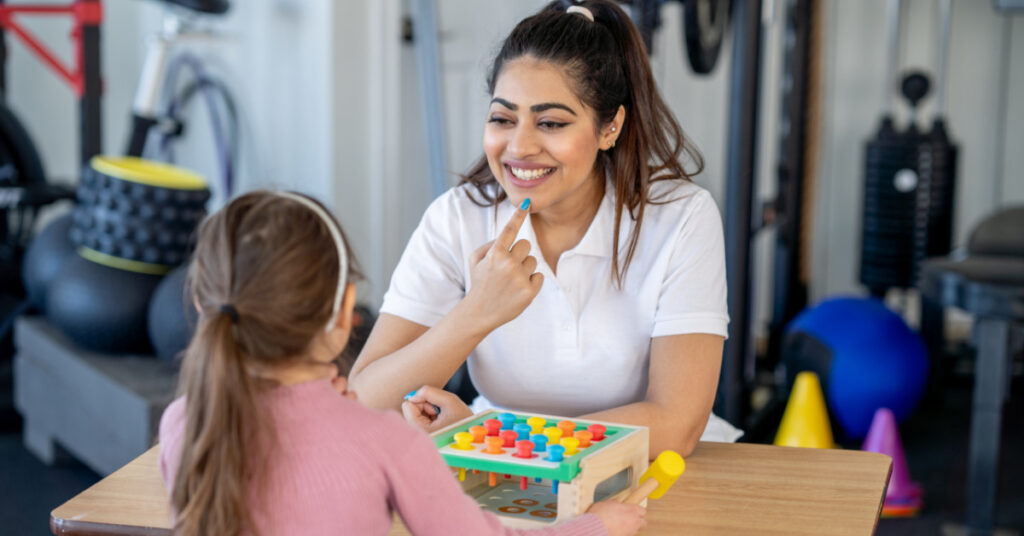
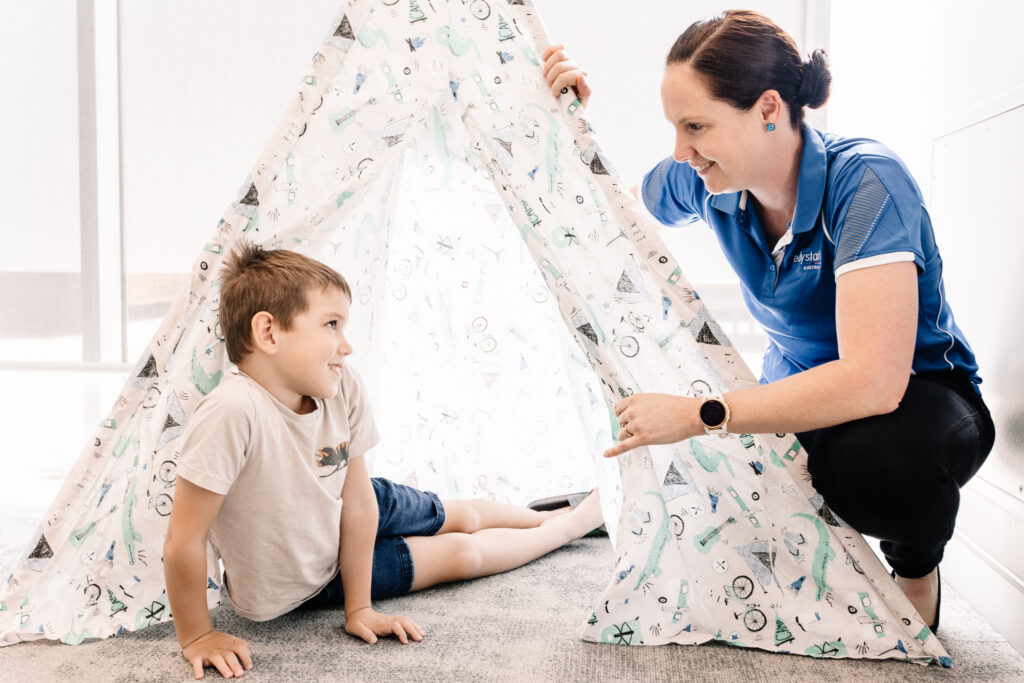
Child centred and play based therapies are commonly embraced because they help reduce stress by making interaction and communication a more natural and engaging experience for your child. These evidence-based approaches use play as a medium for communication, emotional expression, and skill development. Sharing focus on an activity, pretend play, sensory activities, construction and movement are all ways to establish joint interaction, maintain focus, develop imaginative thinking and flexibility, and stimulate self-expression.
7. Carer skill development and capacity building
At Early Start Australia, we are committed to building upon your many strengths. We adopt a coaching and mentoring approach to empower you and your family to be the experts in your child’s preferences and help you to implement strategies in their everyday life. We will work closely with you and provide information, guidance and resources along the way to assist you and your child build meaningful relationships and thrive as confident and valued individuals in the world around you.
Frequently Asked Questions
Can nonverbal autistic children learn to speak?
Yes. Particularly with early intervention and therapeutic support, spoken language skills can develop as late as adolescence. Even when spoken language does not develop, many children become proficient communicating via other means, such as assistive tools or sign language.
Is AAC a replacement for speech?
While AAC can be the only way for some children to communicate, it can also be an important additional tool for supporting children who are struggling with speech and has in fact been shown to support spoken communication skills for many children with autism.
Do communication devices delay speech?
No, research consistently shows that Augmentative and Alternative Communication (AAC) systems do not delay or hinder the development of speech. Instead, they act as beneficial tools that support, encourage, and often increase verbal speech by reducing frustration and providing a visual/auditory model for language.
What age should communication therapy start?
Communication-focused therapy supports should start as soon as your child is diagnosed with autism, ideally before they turn 3. In extreme cases, a lack of response to their name, eye contact or gestures may signal the need for intervention as early as 12 months, and if your child has not produced any words by age 16-18 months, this would also signal the need for intervention.
When to Seek Professional Support
The earlier you get help the sooner you can make a big difference. Currently, your GP can refer you to one of our early developmental therapists for an assessment that can be used to seek funding for therapy support, assistive technologies or home modifications. To learn more about our therapy services please contact us on 1300 372 439.