



Building Communication Skills for Confidence in Term 1

Essential Communication Skills and How Speech Pathology Helps
Hi, my name is Olivia, and I’m a Speech Pathologist at Early Start Australia (ESA). I’ve been part of the ESA community for over three years now. I first joined as a Therapy Assistant during my fourth year of university and quickly fell in love with the work. Supporting children and watching their confidence grow remains one of the most rewarding aspects of my role.
Each year, I see a large influx of referrals once school has already begun. Teachers start to notice areas where children may need extra support, and families suddenly find themselves navigating long waitlists. That’s why December and January are an ideal time to consider therapy. This early start gives your child time to settle into sessions, build rapport with their therapist, and begin working toward goals like communication skills, before the busy school term begins.
As Speech Pathologists, we support a wide range of communication skills. Teachers most commonly refer children for support in three key areas:
• Language — how children use and understand words, sentences, and stories
• Speech — how clearly children pronounce sounds and words
• Social communication — how children interact, play, and connect with others
These communication skills lay the foundation for learning, forming friendships, following routines, and feeling confident at school. Below is a breakdown of each area and what families can keep an eye on as Term 1 approaches.
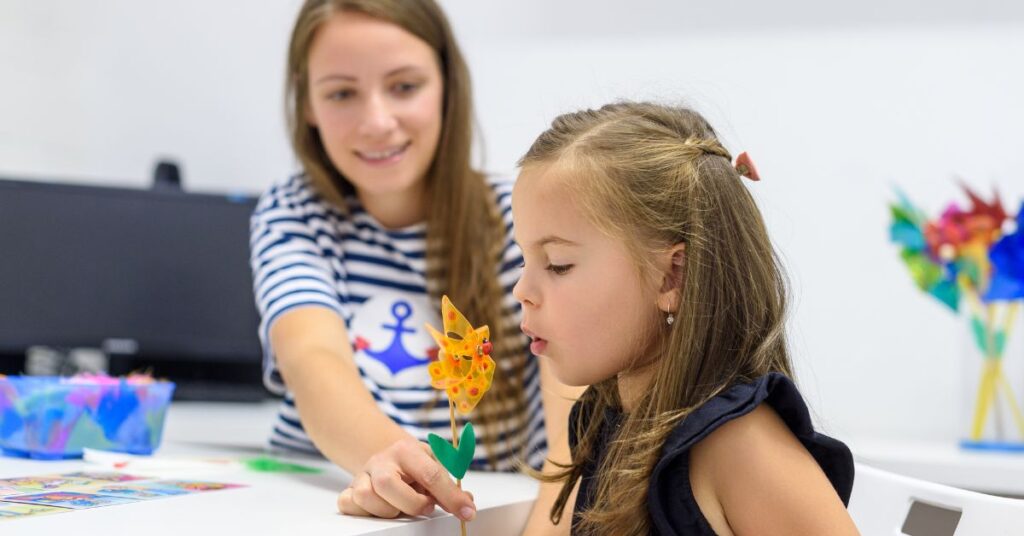
Language
Language includes both expressive language (what children say) and receptive language (what they understand). Strong language foundations enable children to share their ideas, ask for help when needed, understand instructions, and fully participate in classroom activities.
Expressive Language – Semantics
Semantics is a key part of expressive language. It refers to the meaning of words and how words relate to one another. Children with strong semantic skills develop a wide and flexible vocabulary.. They can choose more specific words, learn new words more easily, and build rich “word networks” that support clear and confident communication skills.
Children develop these word networks naturally through play, conversations, shared reading, and everyday experiences. Over time, they begin to understand subtle differences between words, connect new ideas to what they already know, and retrieve the right words more easily.
Strong semantic skills are especially important for school. They help children communicate their needs and wants, express their ideas clearly, and participate confidently in classroom conversations and activities. A strong vocabulary also supports early reading, writing and communication skills, making it easier for children to feel successful in the classroom environment.
What might it look like if my child is having difficulty with semantics?
You might notice your child:
- Has a limited vocabulary or relies on the same words repeatedly
- Uses very general words such as “thing”, “that”, or “you know…”
- Becomes frustrated when trying to explain something
How can a Speech Pathologist help?
A Speech Pathologist can:
- Help expand your child’s vocabulary through fun and engaging activities
- Strengthen the connections between words and concepts
- Support word-finding skills
Expressive Language – Syntax
Syntax is another key part of expressive language. It refers to how children combine words to form sentences. This includes putting words in the correct order, adding grammatical markers such as plurals or “-ed” and “-ing,” building longer and more complex sentences, and joining ideas with connecting words like “and,” “but,” and “because.”
As children develop, their sentences naturally become more detailed, organised, and expressive. For example, they may move from “Dog run” to “The dog is running,” and later to “The dog is running fast because it’s excited.”
Strong syntax skills are important for school because they help children explain their ideas clearly in class, use full sentences when speaking or writing, and describe events, stories, and experiences in a way that others can understand. Syntax also supports clear answers to questions, confident participation in classroom discussions, and the ability to organise thoughts in a meaningful sequence. These skills are essential not only for academic learning but also for social communication skills and everyday interactions.
What might it look like if my child is having difficulty with syntax?
You might notice your child:
- Uses short or incomplete sentences
- Leaves out important grammar markers (e.g., “She go store” instead of “She is going to the store”)
- Mixes up word order
- Finds it hard to explain events, ideas, or stories
How can a Speech Pathologist help?
A Speech Pathologist can:
- Teach grammar and sentence patterns in child-friendly ways
- Practice building longer, clearer sentences
- Support your child to explain ideas, events, and stories with confidence
Receptive Language
Receptive language refers to how children understand the words, sentences, and instructions they hear. When a child follows an instruction such as “put your shoes on,” points to something you’ve named, or answers a simple question, they are using their receptive language skills.
Receptive language is crucial for academic success because it lays the foundation for classroom learning and daily routines. Children who understand spoken language can follow instructions during activities and transitions, participate in group discussions, and respond confidently to questions from teachers and peers.
Strong receptive language also helps children learn new concepts, stay organised, and feel less overwhelmed in busy or noisy environments. Because it supports learning, behaviour, social interaction, and emotional confidence, receptive language is one of the strongest predictors of success across the early school years.
What might it look like if my child has difficulty with receptive language?
You might notice your child:
- Struggles to follow instructions (especially multi-step directions)
- Finds it difficult to answer simple “who”, “what”, “where”, or “why” questions
- Guesses answers or often says “I don’t know”
How can a Speech Pathologist help?
A Speech Pathologist can:
Give your child simple supports that make listening and understanding feel easier
Build skills for understanding and answering a wide range of question types, from simple “what” questions to more complex “why” and “how” questions
Teach important concepts such as size words (big/small), location words (in/on/under), and time words (before/after) to support understanding of classroom instructions
Speech
Speech refers to the speech sounds a child uses when they talk and how clearly their words can be understood. Clear, intelligible speech helps children communicate confidently with teachers and peers, express their ideas in class, and develop early literacy skills (because sounding out words relies on strong speech sound awareness).
Speech – Articulation
Articulation refers to how the tongue, lips, teeth, and jaw physically make speech sounds. Some children find certain movements tricky and may consistently produce a sound incorrectly. For example, a child may say “thun” for “sun” or “wabbit” for “rabbit” because the mouth movements needed for the correct sound are still developing. Articulation errors usually affect just one specific sound and are not part of a larger speech pattern.
What might it look like if my child has difficulty with their articulation?
You might notice your child is finding some sounds harder to learn than expected for their age. For example:
- Early sounds like p, b, m, t, d, n, h, and w are usually clear by about 2–3 years, so continued difficulty may be a sign that they need extra support
- Sounds such as k, g, f, and y typically develop by around 3–4 years, so replacing or avoiding these sounds after this age may indicate a challenge
- Sounds like s, z, l, sh, ch, j generally develop by 4–5 years, so ongoing errors may affect clarity
- The r sound is trickier and may take until around 6 or older, but noticeable difficulty past this age can be worth checking
How can a Speech Pathologist help?
A Speech Pathologist can:
- Teach and demonstrate the specific mouth movements needed for new sounds
- Practise target sounds through fun, play-based activities
- Support your child to use new sounds automatically in everyday speech
Speech – Phonology
Phonology refers to the sound patterns children use as they learn to talk. Instead of struggling with a single sound, children sometimes use patterns that simplify words. These patterns are typical in early development but are expected to fade as speech matures. For example, a child might say “tat” for “cat” because their brain chooses an easier front sound. This is developmentally normal up to a certain age.
What might it look like if my child has difficulty with their phonology?
You may notice that your child is using sound patterns that make their speech harder to understand, or is continuing to use these patterns for longer than expected. Support may be helpful if your child continues to use these patterns past the typical age, uses several patterns at once, is often difficult for others to understand, or becomes frustrated when trying to communicate.
For example, these are some common phonological patterns and the ages they usually resolve:
- Fronting (“tat” for “cat”) usually resolves by around 4 years
- Stopping (“tun” for “sun”; “doo” for “zoo”) usually resolves between 3 and 5 years, depending on the sound
- Cluster reduction (“pider” for “spider”; “geen” for “green”) usually improves by about 4–5 years
- Final consonant deletion (“ca” for “cat”) usually resolves by around 3 years
- Weak syllable deletion (“nana” for “banana”) usually resolves by about 4 years
How can a Speech Pathologist help?
A Speech Pathologist can:
Support your child to use clearer speech in everyday situations in a way that feels achievable and confidence-building can support your child and family or contact us today to learn more or book an appointment.
Identify which sound patterns your child is using and whether they are developmentally expected
Teach new sound rules through play, visuals, and meaningful activities

Social Communication
Social communication refers to how children use language with others. It involves not only the words they choose, but how they express themselves, how they interpret the people and environment around them, and how they participate in shared interactions. These skills develop gradually over childhood and include understanding and expressing emotions, recognising social cues such as facial expressions and tone and sharing experiences with others.
These skills do not develop on a single timeline, and they do not manifest in the same way for every child. Autistic children, for example, often engage socially in ways that are more direct, more action-based, and more interest-driven, and all of these ways of connecting are valid parts of human social diversity. When social communication skills are supported in a neuro-affirming way, children are more able to navigate busy school moments with confidence, regulate their emotions, advocate for their needs, and form meaningful relationships.
Strong social communication skills are not about “fitting in” or copying typical social skills. It is about helping each child express themselves authentically, connect in ways that feel safe and natural, and participate in school life without pressure to mask or change who they are.
What might it look like if my child needs extra support with their social communication skills?
You might notice your child:
- Prefers solo play because it feels predictable and calming
- Doesn’t always pick up on subtle cues like tone or facial expressions, especially when overwhelmed
- Finds turn-taking or sharing tricky when their brain is already working hard
- Becomes overwhelmed in busy group situations with lots of sensory or social input
- Needs support to understand others’ perspectives, especially during fast-moving interactions
- Finds conflict or problem-solving with peers challenging without adult support
How can a Speech Pathologist support my child?
A Speech Pathologist can support your child by:
- Building social understanding through play, visuals, modelling, and co-regulated experiences
- Supporting them to join in play at their own pace and develop meaningful friendships
- Expanding emotional language in ways that feel accessible and non-demanding
- Practising turn-taking and back-and-forth conversations in playful, pressure-free ways
- Guiding them through problem-solving and communication during tricky peer moments
Social communication therapy is centred on connection, safety, and authenticity, never on changing who a child is. Our goal is to support each child’s natural strengths and help them participate meaningfully in the social environments that matter to them.
Beginning therapy before school starts gives your child time to build a trusting relationship with their therapist, learn helpful strategies before the classroom becomes busy, and practise important school-based skills, like communication in a calm and supportive environment. This early support helps children enter Term 1 feeling settled, confident, and ready to thrive.
Early Start Australia has availability for speech therapy. Contact us now to get started.